

Introduction
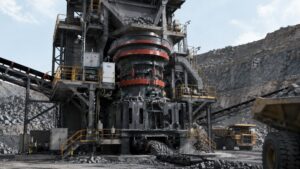
Primary crushing is currently measured by equipment uptime, accurate data, and swift maintenance. In the active gyratory crushers market, mining sites need a robust stationary crusher. This machine must handle tough rock. It also needs to track working conditions and lower the chance of sudden shutdowns. At HiDerek Mining Machine, we view the RG4265 as a vital primary crushing tool. Here, smart automation and easy service access directly impact overall profits.
How Does a Gyratory Crusher Work with Automation?
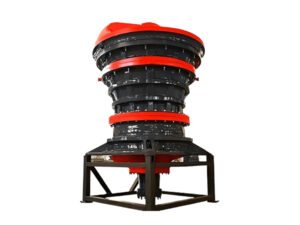
A full explanation of how does a gyratory crusher work must involve modern control systems. The main shaft holds the mantle in place. Next, the eccentric assembly generates the necessary gyrating motion. The concaves provide a sturdy fixed crushing surface. Finally, the lubrication and hydraulic systems keep the machine safe under heavy loads.
Automation transforms this physical action into a smoothly managed cycle. The HD coarse crushing design utilizes smart control features. It offers real-time tracking of oil temperature, oil flow rate, internal pressure, crusher load, and machine vibration. These vital signals allow plant operators to spot unusual conditions early. As a result, they can prevent liner damage, bearing strain, lubrication breakdowns, or an unexpected plant halt.
What Should Buyers Know About the RG4265 Stationary Crusher?
For buyers looking at a gyratory crusher for sale, the specific technical details must match the local site. The RG4265 is built specifically for primary crushing in permanent plants. Its core values directly influence the foundation weight, raw feed planning, electrical power needs, and downstream processing capacity.
| Specification Area | RG4265 Value | Practical Meaning |
| Machine weight | 120,000 kg | Defines foundation, lifting, and installation planning |
| Feed opening | 1066 mm | Accepts large primary feed before secondary crushing |
| Motor power | 450 kW | Supports hard-rock coarse crushing under load |
| Maximum output | 2870 mtph | Helps match crusher capacity with conveyors and bins |
| Application type | Stationary crusher | Fits fixed mine and quarry crushing stations |
These numbers clearly show why buying just a cheap gyratory crusher can be a huge risk. A low upfront price will not fix issues caused by an undersized feed opening. It also cannot solve weak power matching, bad service access, or basic control limits. The RG4265 has a 120,000 kg weight, a 1066 mm feed opening, 450 kW motor power, and a 2870 mtph peak output.
Why Does Real-Time Monitoring Reduce Downtime?
Primary crushing errors spread very quickly. A plugged discharge area, uneven feed, abnormal vibration, or an oil issue can halt haul trucks. It can also stop conveyors and downstream crushing stages. Because of this, live monitoring is now a major buying requirement within the global gyratory crushers market.
Oil temperature indicates lubrication stress levels. The oil flow rate proves if the fluid circuit is running smoothly. Pressure data reveals the hydraulic status and the actual crushing load. Vibration alerts the team to heavy impacts or growing mechanical faults. Load tracking prevents both underfeeding and severe overload. Consequently, the crew can adjust the incoming feed or plan maintenance tasks much sooner.
How Should Maintenance Design Influence a Purchase?
A cheap gyratory crusher might seem appealing during the initial sourcing phase. However, unexpected downtime usually costs much more than the money saved early. The HD coarse crushing design features revolving frame technology and hydraulic separation. It also includes an integral lifting frame paired with the fixed cone liner. These features provide safer service conditions. Furthermore, they cut planned downtime by up to 70%.
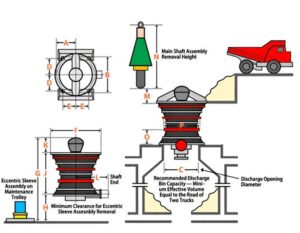
The physical site layout is also very important. Proper dimension planning must verify the overall crusher footprint. It should also check the main shaft removal height and the eccentric sleeve trolley clearance. In addition, the discharge opening size and the bin capacity need careful review. The dimension guide also stresses the need for a discharge bin with plenty of usable volume. This prevents costly material bottlenecks right below the crusher.
What Do Real Project References Show?
Picking the right crusher becomes much safer when it relies on actual field conditions. Our past project history includes a 1000 t/h iron ore site in Kazakhstan and a 1200 t/h bauxite mine in Sierra Leone. Our project references also include a 700 t/h iron ore plant in the UAE and a 3000 t/h iron ore production project in Inner Mongolia. These real-world cases prove why rock hardness, feed grading, and moisture matter. Moreover, they show that discharge design and spare parts availability must be evaluated together.
How Should Buyers Compare Gyratory Crusher Distributors?
Good gyratory crusher distributors must do much more than just email a basic quotation. A reliable distributor will carefully check the rock feed size and the specific ore type. They should also review the target output, the foundation space, and the overhead lifting clearance. Additionally, they must look at the discharge design, smart automation needs, spare parts supply, and future after-sales training.
Before asking for a gyratory crusher for sale quote, buyers need to gather their ore data and site layout drawings. They should also prepare daily working hours, haul truck details, and downstream conveyor limits. Finally, they must list their exact monitoring needs. Total capacity relies heavily on material traits, feed spread, work index, and rock moisture. It also depends on the feeding method. Therefore, the final machine choice must be strictly based on the specific application.
Conclusion
The main question is not just how does a gyratory crusher work. The real issue is how well it runs while handling hard rock, changing feed sizes, and massive loads. It must also perform well during short maintenance windows. Today’s gyratory crushers need to blend raw crushing power with smart automation. They must also offer live monitoring, safe worker access, and solid technical support.
FAQ
How does a gyratory crusher work in primary crushing?
It crushes raw rock between a moving mantle and stationary concaves. The mantle gyrates continuously inside the concaves. Thus, new feed drops from the top, and the broken material falls out below.
Is a cheap gyratory crusher suitable for hard-rock mining?
It is only acceptable if it perfectly matches the needed feed size, power, and capacity. It must also meet wear life, automation, and daily service needs. A low price by itself is never enough.
What should buyers check before choosing a stationary crusher?
Buyers must verify the top feed opening, rock hardness, and the required hourly output or target capacity. They should also check the motor power, base foundation load, and roof lifting clearance. Furthermore, they need to review the discharge bin layout, smart monitoring tools, and maintenance access points.
How do gyratory crusher distributors support after-sales service?
They should assist with exact model selection and site layout checks. They must also help with final installation, initial commissioning, and spare parts stocking. Lastly, they provide operator training and fix technical problems after the plant starts running.
What information is needed for a gyratory crusher for sale quotation?
You must provide the exact ore type, material bulk density, and the largest feed size. Also, share the needed hourly output, rock moisture level, and site layout plans. Finally, include the local power setup, the planned discharge method, and any specific automation requests.