
Introduction
Mining operations face growing pressure to reduce transport costs. They also need to enhance output stability and adapt to shifting ore conditions. This explains why discussions regarding the benefits of on-site rock crushing and high-capacity primary crushing systems are now central to project planning. As massive mines expand, the gyratory crushers market continues to grow. This growth is fueled by a strong demand for continuous, heavy-duty processing equipment. Within this context, understanding how a gyratory crusher works is vital. Knowing how it compares with a stationary crusher—such as those offered by HiDerek Mining Machine—is equally critical for boosting long-term operational efficiency.
Why benefits of on-site rock crushing matter today
The benefits of on-site rock crushing stem mostly from the need to decrease material movement across mining sites. When ore is processed right near the extraction point, hauling distances drop quite a bit. This reduction lowers fuel usage and decreases truck dependency. Consequently, it helps stabilize production schedules. Crushing capacity is no longer restricted by far-off processing plants.
Another crucial element is ore control. On-site systems let operators manage material quality much earlier in the process. This early control minimizes dilution and boosts downstream efficiency. These operational perks are a primary reason the gyratory crushers market continues to expand. This is particularly true in large open-pit mines. In these locations, material volume is massive, and logistics costs dominate overall production expenses.
How does a gyratory crusher work in real applications
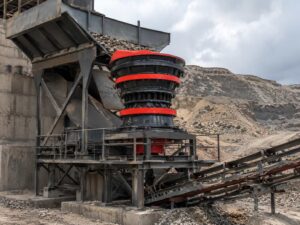
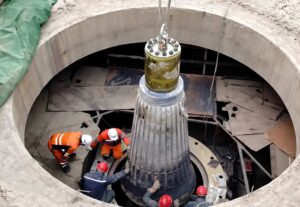
To fully grasp how does a gyratory crusher work, you must focus on its continuous compression mechanism. A gyratory crusher operates using a central main shaft. This shaft performs a slow gyrating motion inside a fixed concave shell. As the eccentric sleeve turns, the mantle continuously presses the ore against the crushing chamber walls.
This gyratory crusher working principle establishes a steady crushing cycle without complete stops. It is quite different from intermittent systems. Material enters from the top. It is then progressively compressed. Finally, it discharges from the bottom in a steady flow. This continuous action makes it ideal for high-volume primary crushing. It is especially useful in hard rock mining, such as copper and iron ore operations.
The stability of the gyratory crusher working also permits it to manage varying feed sizes without a big drop in performance. This is a major reason it stays a core solution in large mining circuits. In these setups, consistency and high throughput matter more than sheer flexibility.
Gyratory crusher working inside HD Series
Modern gyratory crusher working systems combine automation and hydraulic control to boost operational stability. In HD Series coarse crushing setups, the crusher is built for high-capacity primary crushing. It features optimized chamber geometry and strong structural reinforcement.
Based on engineering data from HD Series systems, the key specifications include:
Model Feed Opening Power Capacity Range (t/h) Feature Focus
42-65 1065 mm 375 kW up to 3165 compact primary crushing
54-75 1370 mm 450 kW up to 3845 higher energy output
60-110E 1524 mm 1200 kW up to 9800 ultra-heavy duty mining
These parameters demonstrate how the gyratory crusher works scales with mining demands. Larger systems focus heavily on throughput stability, wear resistance, and non-stop operation. In the RG4265-class design, hydraulic assistance boosts maintenance efficiency. It does this by cutting down downtime during liner replacement and regular component inspection.
Stationary crusher vs on-site crushing systems
A stationary crusher is usually set up in fixed processing plants with permanent infrastructure. It delivers stable, long-term operation. However, it requires the ore to be moved over longer distances. This transport increases logistical complexity and drives up operational costs.
In contrast, on-site crushing cuts down transportation steps. It also enhances production flexibility. While stationary systems stay important for centralized plants, they are less adaptable to rapidly shifting mine layouts. This difference is growing more significant as mines spread across larger and more isolated areas.
The comparison can be summarized as follows:
Factor stationary crusher On-site crushing
Mobility fixed flexible
Cost structure higher transport cost lower haulage cost
Setup permanent infrastructure modular deployment
Application long-term plants dynamic mining sites
This operational gap continues to impact the gyratory crushers market. It is especially true in regions where mining projects strongly prioritize mobility and strict cost control.
Gyratory crushers market growth drivers
The gyratory crushers market is expanding due to a rising need for high-capacity crushing equipment in large-scale mining. As ore grades drop globally, mines must process much more material. This situation increases the reliance on massive primary crushers.
Another key driver is modernization. Many older stationary crusher systems are now being replaced with automated gyratory units. These new units boost energy efficiency and cut down on downtime. Digital monitoring and hydraulic adjustment systems also enhance the gyratory crusher’s working stability. This technology allows operators to optimize machine performance in real time.
Conclusion
The choice between a stationary and an on-site crushing setup is no longer just about equipment preference. It is fundamentally about long-term cost structure and operational flexibility. As the benefits of on-site rock crushing continue to transform mining logistics, gyratory systems remain vital for high-capacity primary crushing. Understanding how a gyratory crusher works is essential. Knowing how the gyratory crusher works and how it integrates into modern plant design is key to boosting productivity and lowering operational risk in large mining projects.
FAQ
How does the gyratory crusher improve mining efficiency?
Gyratory crusher working improves efficiency through steady, continuous compression crushing. This action ensures a stable output and greatly reduces interruptions in large-scale mining operations.
What are the main benefits of on-site rock crushing in mining projects?
The benefits of on-site rock crushing include a lower transport cost. They also offer better material control and yield faster processing cycles right at the extraction point.
How does a gyratory crusher work in high-capacity operations?
How does a gyratory crusher work involves a rotating eccentric system. This system continuously presses the ore between the mantle and the concave surfaces to produce a steady output.
Why is a stationary crusher still widely used in mining plants?
A stationary crusher is utilized for its strong structural stability. It offers long-term reliability in centralized processing facilities that have established infrastructure.
What is driving the gyratory crushers market growth globally?
The gyratory crushers market is growing due to the increasing demand for mining output. Equipment upgrades and the pressing need for more efficient primary crushing systems also drive this expansion.