
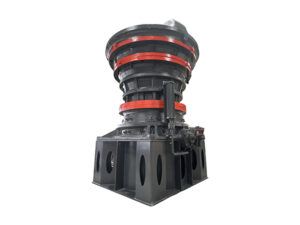
Mining operations face ongoing demands to raise output, cut energy use, and limit stoppages. At the center of these tasks sits the gyratory crusher, a key piece of equipment for breaking large ore and rock. Its performance shapes daily volume, running costs, and total site results. Managers, engineers, and planners therefore study how industrial rock crusher efficiency shapes production numbers before they make decisions on equipment.
What Is a Gyratory Crusher and How Does It Operate?
A gyratory crusher handles large volumes of ore and rock at mine locations. It differs from jaw models because it uses a cone shape. A fixed outer cone works with an inner cone that moves in a circular pattern. Rock breaks as it travels downward inside the chamber.
Main parts that drive the process include the shaft and eccentric assembly. These parts create the circular motion. Liners on the moving and fixed cones withstand heavy pressure. Hydraulic units support safe service work by lifting and separating large sections.
Newer high-capacity rock crushers from a leading crusher company often connect to monitoring tools. These tools track load, vibration, oil temperature, and pressure in real time. The data helps crews keep control, avoid sudden stops, and raise daily output.
Why Is Crusher Efficiency Critical for Mining Site Output?
Performance levels in a gyratory crusher affect three main areas. Throughput and total capacity form the first area. Energy use per ton of rock forms the second. Wear on parts and time between service stops form the third.
HiDerek Mining Machine’s HD Series coarse crushing gyratory crushers deliver up to 30 percent more volume than older models. Better speeds, stronger design, and correct power settings help reach output targets while keeping the equipment footprint small.
How Can On-Site Crushers Enhance Mining Productivity?
Placing an on-site crusher brings several clear gains. Haul distances between the face and the crusher become shorter. Raw material reaches a usable size right away. Discharge bins match truck sizes and avoid pile-ups. The units link smoothly with feeders, screens, and belts.
When high-capacity rock crushers work with strong feeders such as the HBF and GDS series, material keeps moving without breaks. One iron ore site in Inner Mongolia runs at 3,000 tons per hour using HD Series gyratory crushers paired with dual-shaft feeders.
What Are Common Mining Site Crusher Challenges?
Mine teams meet several mining site crusher challenges. Feed size and rock hardness can often change. Moisture or sticky ore can cause jams. Liners and moving parts wear out. Planned and unplanned stops interrupt work. Capacity must stay in step with later stages of the plant.
Good choices on crusher size, automatic sensors, and advice from crusher equipment manufacturers help control these issues. The crusher equipment manufacturer’s guide gives clear steps for setup, daily use, and service work.
How Do Crusher Equipment Manufacturers Ensure High Efficiency?
Top crusher equipment manufacturers improve results through design, new features, and control systems. Revolving frames and hydraulic lifts cut service time by as much as 70 percent. Sensors give live updates on running conditions. Strong lubrication, bronze bushings, and seals protect the machine in dusty and vibrating spots. Bidirectional release systems stop stalls when uncrushable items enter the chamber.
The crusher equipment manufacturers’ guide shows how to raise volume while lowering wear, power use, and service costs.
What Factors Determine Optimal Gyratory Crusher Efficiency?
Several settings and design choices shape final performance. Feed size and how the material spreads inside the chamber matter first. Uniform feed prevents jams and uses the full chamber. Rock hardness, water content, and how easily it breaks affect the crushing ratio. Speed, eccentricity, and closed-side setting change output directly. Good links to belts, bins, and screens raise total volume. Live monitoring and automatic wear adjustment keep results steady.
Sites that watch these points record higher daily output and lower running costs, especially when they run high-capacity rock crushers at the working face.
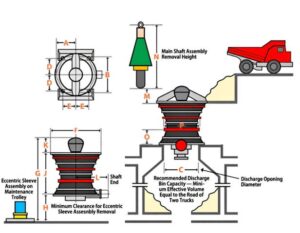
Detailed Product Specification Comparison
The table below lists key HD Series gyratory crushers from HiDerek Mining Machine. It shows feed opening, installed power, and rated capacity for each model.
| Model | Feed Port (mm) | Power (kW) | Max Processing Capacity (t/h) | Weight (kg) |
| 42-65 | 1065 | 375 | 2,870 (for 175mm) | 119,750 |
| 50-65 | 1270 | 375 | 2,935 (for 175mm) | 153,300 |
| 54-75 | 1370 | 450 | 3,485 (for 200mm) | 242,220 |
| 60-89 | 1370 | 600 | 5,805 (for 230mm) | 398,250 |
| 60-110E | 1370 | 1,200 | 8,890 (for 250mm) | 553,383 |
Each model supports industrial rock crusher efficiency by limiting stops and moving the largest possible volume. The design lets crews swap liners, lift frames, and eccentric parts quickly, which lowers service hours.
Why Investing in High-Efficiency Crushers Improves ROI
High-efficiency gyratory crushers bring four main gains. Energy use per ton drops. Labor and service costs fall because sensors and hydraulic aids handle much of the routine work. Product size stays steady, which helps later stages run better. The same machine can handle different ore types and site conditions.
Two real-world lines, one in Xinjiang at 2,000 tons per hour and one in Linyi at 1,000 tons per hour, show that HD Series on-site crushers raise output and shorten payback time.
How to Choose the Right Crusher for Your Mining Site
Picking the right unit starts with a few checks. First, confirm the needed volume and ore traits. Next, review the crusher equipment manufacturer’s guide for model suggestions. Then, check the space and foundation needs. After that, look at service access and how the crusher will work with feeders and screens. Finally, verify that the installed power meets peak demand.
Rock crushing companies usually recommend a site visit to match the machine with daily goals.
Conclusion
The performance of a gyratory crusher sets the pace for mine output. Strong, high-volume units cut stops, lower energy use, and improve material flow. Guidance from crusher equipment manufacturers plus live monitoring systems, helps teams reach steady volume while managing typical mining site crusher challenges. HiDerek Mining Machine combines new design, control tools, and solid build quality so mines can hit targets with steady results.
FAQ
What is the ideal HiDerek gyratory crusher for high-capacity mining sites?
The best model depends on feed opening, rock strength, and target volume. Large operations often select the HD Series 60-110E. It offers a 1370 mm feed port, 1,200 kW power, and up to 8,890 tons per hour. These numbers deliver top industrial rock crusher efficiency.
How do on-site crushers improve operational efficiency?
Placing crushers near the working face shortens truck runs. Material receives first sizing at once. Real-time feed control prevents delays. These steps raise daily output and help rock crushing companies reach goals on schedule.
Can the crusher equipment manufacturer’s guide help reduce downtime?
The guide lists service steps, correct settings, and installation checks. Crews follow these steps to keep machines running longer. The result is steady output from each high-capacity rock crusher.
What are the key mining site crusher challenges and solutions?
Feed changes, wet ore, and part wear create most stops. The right model size, sensor systems, and planned service work reduce these issues. HiDerek Mining Machine and other crusher equipment manufacturers supply the needed advice.
Which features of a gyratory crusher maximize industrial rock crusher efficiency?
Hydraulic lift frames, live monitoring, rotating main frames, quick-change liners, and tramp release systems all help. Together, they cut lost time, raise volume, and keep product size steady across shifts.