
 |
 |
Single-Cylinder vs. Multi-Cylinder Hydraulic Cone Crushers: Engineering Comparison & Selection Guide
1. Introduction: Debunking the Technology Selection Myth
In modern mineral processing and aggregate production, the conical crusher is the mainstay of secondary, tertiary and quaternary crushing circuits. As the industry gradually phases out traditional mechanical spring cone crushers, the hydraulic conical crusher has become the global standard due to its automatic closed system (CSS) adjustment and metal waste protection functions.
Within the market, two distinct design philosophies dominate:
- Single-Cylinder Hydraulic Cone Crushers (e.g., HST / GP series)
- Multi-Cylinder Hydraulic Cone Crushers (e.g., HP series)
Over the years, aggressive marketing has led some plant operators to mistakenly believe that multi-cylinder crushers are inherently “more advanced” due to their mechanical complexity. However, in heavy engineering, an increase in complexity does not always mean higher efficiency. Equipment selection is not based on the number of components, but on finding the best balance among kinematic reliability, supply characteristics, operational availability, and life cycle cost (LCC).
2. Structural Mechanics & Kinematic Pathways
The significant difference between single-cylinder and multi-cylinder cone crushers lies in the way the main shaft is supported and the manner in which the crushing force is transmitted.
2.1 Floating Main Shaft vs. Fixed Main Shaft
Single-Cylinder Design (Floating Main Shaft):
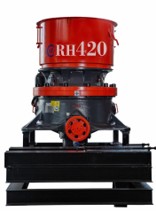
The main shaft and the moving cone (mantle) are integrated into a single floating assembly. The entire shaft is supported directly from underneath by a single, large-diameter hydraulic cylinder. As the eccentric bushing rotates around the shaft, the main shaft and mantle gyrate together. Crushing forces are absorbed by the bottom hydrostatic oil film and the heavy-duty lower frame.
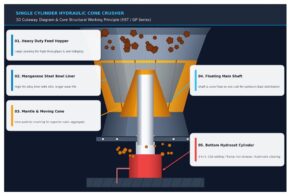
Figure 1: Schematic Diagram of the Physical Structure of a Single-Cylinder Hydraulic Cone Crusher and the Actual Configuration of the “Floating Main Shaft”
Multi-Cylinder Design (Fixed Main Shaft):
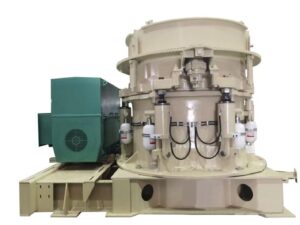
The main shaft is rigidly locked onto the central hub of the main frame using high-strength bolts and does not move. The moving cone assembly sits over this stationary shaft like a spherical cap. Eccentric rotation drives only the moving cone mantle. The crushing counterforce is held from the top by 6 to 16 peripheral hydraulic clamping cylinders securing the bowl liner downward.
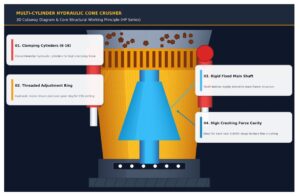
Figure 2: Schematic of the physical structure of a multi-cylinder hydraulic cone crusher and its “fixed main shaft + top multi-cylinder” configuration
2.2 The “3-in-1” Hydraulic Integration vs. Functional Separation
The core engineering highlight of the single-cylinder cone crusher is its high degree of functional integration:
- Continuous Online CSS Adjustment: As hydraulic fluid is pumped into or drawn out of the lower cylinder, the entire floating shaft moves up and down, enabling micrometer-level precision adjustment under load.
- Instantaneous Metal-Jamming Relief: When an indestructible object (such as a drill bit tooth or metal shavings) enters the chamber, the hydraulic circuit immediately depressurizes, causing the spindle to drop vertically and eject the foreign object.
- Chamber Clearing: If a power outage occurs while the load is at full capacity, the cylinder will fully lower the cone within a few minutes to clear the chamber.
In contrast, multi-cylinder machines rely on functional separation:
- CSS adjustment requires a hydraulic motor driving a massive mechanical ring-and-thread mechanism.
- Cavity locking force is maintained continuously by the top peripheral hydraulic cylinders.
- Tramp iron release relies on nitrogen accumulator synchronization across multiple cylinders.
While functional separation allows high clamping force, it substantially increases hydraulic piping, fitting connections, and mechanical wear points.
2.3 Structural Simplification & Weight Distribution
By eliminating the top lock cylinders, mechanical adjustment threads, and intricate hydraulic sync manifolds, a single-cylinder cone crusher contains roughly 40% fewer parts than a multi-cylinder crusher of equivalent capacity.
Fewer components lead to major engineering benefits:
- Reduces overall height and center of gravity: Significantly improves equipment stability and reduces dynamic foundation loads.
- Reduce Shipping Weight: Simplify Shipping and On-Site Crane Lifting Logistics.
- Compact Footprint: Ideal for integration into skid-mounted modules and mobile crushing plants.
3. Operational Reliability & Maintenance Ergonomics (MTTR)
In mining operations, continuous uptime is the primary driver of profitability. Mean Time to Repair (MTTR) and Mean Time Between Failures (MTBF) determine true processing efficiency.
3.1 Failure Mode Elimination
Multi-cylinder crushers present two unique operational failure risks:
- Hydraulic Cylinder Desynchronization: If an accumulator loses nitrogen charge or a single valve experiences response lag during an iron-passing event, the adjustment ring tilts. This asymmetric force causes severe eccentric bronze bushing scoring and potential main shaft damage.
- Adjustment Thread Wear/Seizure: The threads on large machinery operate under conditions of severe vibration and in dusty quarry environments. Contaminant ingress or lubricant failure may cause the adjustment ring to become permanently seized, preventing CSS adjustments.
The single-cylinder crusher completely eliminates both failure modes by removing the upper threaded section and using a single central hydraulic cylinder.
3.2 Maintenance Accessibility
- Liner Replacement: On single-cylinder machines, the bowl liner and mantle can be lifted straight out without dismantling extensive top-mounted hydraulic lines.
- Seal & Cylinder Maintenance: The bottom hydraulic cylinder is easily accessible from beneath the crusher foundation, allowing seal servicing in a matter of hours.
- Maintenance Ergonomics: Reduced downtime directly translates into higher annual processing tonnages and lower labor expenditures.
4. Application Suitability & Operating Scenarios
No single crusher fits every crushing stage. Understanding operational boundaries ensures proper equipment allocation.
4.1 Why Single-Cylinder Dominates Secondary Crushing
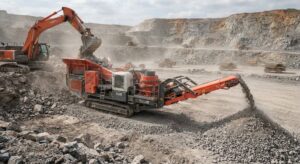
Secondary crushing circuits receive coarse run-of-quarry ore directly from primary jaw or gyratory crushers. Key requirements include:
- Large Feed Intake: Single-cylinder units feature steeper cone angles and wider feed openings, preventing material bridging.
- Fluctuating Feed Handling: Real-time CSS online adjustment dynamically compensates for variations in feed size.
- High Tonnage Throughput: The seamless feed inlet provides a massive throughput capacity for medium-hard to hard ores (such as limestone, dolomite, iron ore, and copper ore)..
4.2 The Ultimate Choice for Mobile Crushing Plants
Mobile crushing plants are subject to strict limitations regarding weight, height, and vibration stability. Their low profile, reduced total mass, and streamlined hydraulic layout have made single-cylinder cone crushers the de facto industry standard for heavy-duty tracked mobile secondary crushing units worldwide..
4.3 Where Multi-Cylinder Excels
Multi-cylinder crushers generate exceptionally high crushing forces at tight closed side settings. They remain the preferred choice for:
- Tertiary / Quaternary Fine Crushing: Processing extremely hard, abrasive rocks (e.g., granite, basalt, quartzite, river gravel).
- Strict Flakiness / Shape Requirements: Producing premium cubical concrete aggregates with minimal elongated/flaky particles.
Comprehensive Head-to-Head Comparison
| Feature / Metric | Single-Cylinder Hydraulic Cone | Multi-Cylinder Hydraulic Cone |
| Main Shaft Configuration | Integrated Floating Shaft (Moves with mantle) | Rigid Fixed Shaft (Stationary on base frame) |
| Adjustment Mechanism | Direct bottom hydraulic cylinder positioning | Mechanical threaded ring driven by hydraulic motor |
| Tramp Iron Relief | Instantaneous vertical single-cylinder dump | Multi-cylinder accumulator group lift |
| Part Count | ~40% fewer components | Higher complexity with distributed cylinders |
| Center of Gravity / Height | Low profile, low center of gravity | Taller machine body, top-heavy weight distribution |
| Feed Opening Capability | Extra-large feed opening, high intake | Medium to compact feed opening |
| Primary Circuit Role | Secondary Crushing / Mobile Crushing Stations | Tertiary / Quaternary Fine Crushing & Shaping |
| Maintenance & MTTR | Fast, straightforward (Lower downtime cost) | Requires specialized pullers & sync calibration |
| Best-Fit Material | Soft to hard minerals & massive secondary bulk | Extremely hard rock fine reduction (<20 mm) |
5. Life Cycle Cost (LCC) Analysis
Total Cost of Ownership (TCO) extends far beyond the initial equipment purchase price. The standardized LCC model is formulated as:
Where:
- = Capital Acquisition Cost
- = Foundation & Installation Cost
- = Energy & Operating Power Consumption
- = Wear Parts & Lubricant Maintenance Cost
- = Unscheduled Downtime Loss
The Single-Cylinder LCC Advantage in Secondary Stages:
- Lower Initial & Installation Cost: Simplified structural manufacturing and fast on-site commissioning reduce initial capital outlay.
- Minimized Spare Parts Inventory: No specialized hydraulic sync seals or threaded adjustment rings to stock.
- Reduced Downtime Losses: Rapid clearing and direct liner replacement minimize unscheduled plant stoppages.
6. Conclusion: How to Choose the Right Crusher
When planning a crushing and screening circuit, plant designers should follow an objective, application-specific framework:
- Choose Single-Cylinder If:
- Your project involves Secondary Crushing following a primary jaw crusher.
- You require large feed intake capacity and maximum throughput.
- You are designing a skid-mounted or tracked mobile crushing plant.
- Your operational goal is low maintenance complexity and high plant availability.
- Choose Multi-Cylinder If:
- Your circuit requires Tertiary or Quaternary Fine Crushing.
- You are processing extremely hard, abrasive igneous rock (granite, basalt, quartzite).
- Strict architectural standards mandate ultra-low flakiness and perfectly cubical particle shape.