
Jaw Crusher Toggle Plate: The Overload Safety Fuse Guide
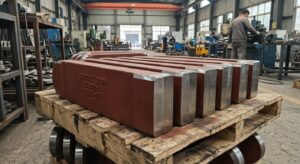
Of all the components in a jaw crusher, the toggle plate appears to be the most unremarkable. It does not come into direct, hard contact with the rock like the jaw plates, nor does it rotate at high speeds like the eccentric shaft. It is simply a flat, rectangular cast iron component that sits quietly between the moving jaw and the rear wall of the frame. However, this seemingly ordinary plate is actually the most critical “safety device” in the entire jaw crusher.
What Is an Toggle Plate?
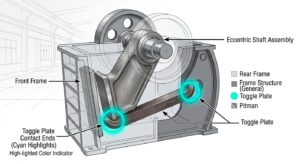
The toggle plate is a cast component with a rectangular cross-section, typically made of ductile iron or medium-carbon cast steel. Both ends are machined into an arc or cylindrical shape; one end rests against the underside of the moving jaw, while the other rests against the toggle plate seat on the rear wall of the frame. Its mounting position, much like a human toggle joint, connects the moving jaw to the frame, hence its name.
Structurally speaking, the Toggle plate plays a rather unique role: it is almost the point in the entire jaw crusher where stress is most concentrated. When the crusher is in operation, with every swing of the moving jaw, enormous crushing reaction forces are transmitted through the toggle plate to the frame. It must be sufficiently sturdy to withstand the loads during normal crushing operations; yet, it cannot be so rigid as to be “unbreakable”—this is precisely what makes its design so ingenious.
Two Core Functions: Force Transmission and Protection
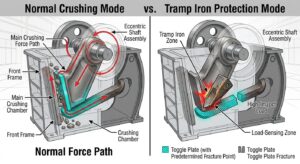
The first function is to transmit crushing force. The moving jaw does not generate crushing force on its own; it relies on the eccentric shaft to drive its reciprocating swing. When the moving jaw approaches the fixed jaw and compresses the rock, the reaction force from the rock pushes the moving jaw backward, and this force is ultimately transmitted back to the frame via the toggle plate. Without the toggle plate, the moving jaw would have no fulcrum to bear the force, and the entire crushing action could not be completed.
The second function—and the one most easily overlooked—is overload protection. Non-crushable objects such as metal chunks, shovel teeth, and drill bits can sometimes find their way into the crushing chamber. When these foreign objects enter, the crushing force can instantly multiply several times over. If left unchecked, components such as the eccentric shaft, bearings, and frame—which are worth hundreds of thousands or even millions—could be violently destroyed. The toggle plate is designed specifically as a “sacrificial component” for this purpose.
Its cross-sectional dimensions and material are rigorously calculated so that it will not break under normal crushing forces; however, once the crushing force exceeds the rated safety limit, it will proactively break at a predetermined weakest point. When the toggle plate breaks, the moving jaw loses its support, and the crushing action stops immediately, thereby protecting the machine’s core components. In this sense, the toggle plate functions much like a fuse in an electrical system: it operates stably under normal conditions but sacrifices itself in the event of an overload.
Why can’t you simply replace it with a thicker toggle plate?
In actual production, some mines—in an effort to reduce downtime caused by toggle plate fractures—replace the original equipment manufacturer’s (OEM) parts with homemade toggle plates made from thicker steel plates. This practice is extremely dangerous.
The reason is simple: the thickness and material of the original toggle plate have been determined through mechanical calculations, and its fracture threshold is precisely set within a specific safety range. While replacing it with a thicker steel plate may indeed make the toggle plate less likely to break, the next time a metal chunk enters the crushing chamber, it could be the eccentric shaft, the bearing housing, or even the main frame that breaks. What would have been a simple toggle plate replacement costing just a few hundred yuan turns into a major equipment overhaul costing hundreds of thousands, amplifying the loss by a thousandfold.
Therefore, an toggle plate “must break when it’s supposed to”—this is not a defect, but its purpose. The value of a qualified toggle plate lies precisely in its ability to protect the entire machine at the lowest cost when it matters most.
How do you determine if an toggle plate needs to be replaced?
Under normal operating conditions, the service life of an toggle plate is influenced by material hardness, crushing frequency, and the presence of iron in the feed. In soft rock applications such as limestone, a single toggle plate can last for half a year or even a full year; in hard rock applications such as iron ore or granite, its service life may be reduced to just a few months.
To determine whether replacement is necessary, examine the curved contact surfaces at both ends of the toggle plate. Normal wear is characterized by the curved surfaces gradually flattening and the gap widening; at this point, the discharge opening will gradually increase and require adjustment. When wear exceeds the manufacturer’s specified limit, or when noticeable dents or cracks appear at either end, the toggle plate should be replaced.
It is important to note that sudden breakage of a cheek plate caused by a metal object passing through the machine is distinct from normal wear and tear. The former is a protective mechanism and should not be considered a quality issue; the latter is normal wear and tear. When purchasing, it is advisable to stock a few extra pieces, especially on iron ore and construction waste processing lines, where the likelihood of foreign objects being mixed in is high, leading to a significantly increased frequency of cheek plate replacement.
Conclusion
Toggle plates are among the least expensive components in a jaw crusher, yet they shoulder the most critical protective responsibility. Understanding their operating principles, respecting their design logic, replacing them on schedule when necessary, and allowing them to break when they are meant to—only then can the entire crusher operate safely and economically. For mining equipment managers, viewing toggle plates as “fuses” rather than troublesome parts that “cause headaches when they break” is a key step toward reducing total cost of ownership.