
Introduction
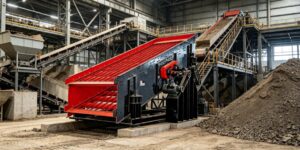
Selecting a mining vibrating screen is not a matter of choosing the largest deck. The correct fixed screen must match feed size, target cuts, moisture, required products, bed depth, and the realistic tonnes per hour reaching the deck. For YA/YAQ thin-oil circular screens, use the stated capacity as a reference range and confirm the actual duty based on feed gradation and operating conditions. This approach protects classification accuracy and downstream stability.
Start With the Separation Duty
A sound specification begins with the separation duty. Record top feed size, bulk density, dry or wet condition, percentage of near-size material, required cut sizes, and the number of saleable products. A screening machine with two decks produces fewer separations than a three-deck arrangement, so deck count follows the flowsheet. HiDerek Mining Machine’s YA/YAQ range is intended for classifying bulk coal, ore, coke, and sandstone in fixed installations.
Define the Feed Before Choosing Apertures
Feed composition determines whether particles can reach an aperture. University of Alaska mineral-processing guidance describes screening as a combination of stratification and probability: smaller particles move toward the deck while particles below the opening pass through. High surface moisture and clay can hinder stratification and promote blinding. Submit a complete sieve analysis, moisture range, clay content, and expected surge instead of quoting only a nominal feed size.
Set a Realistic Capacity Target
Required throughput must be stated as a normal and peak rate. A vibrating screen for mining loses efficiency when an excessive bed prevents undersize particles from reaching the openings. The YA/YAQ models accept feed up to 150 mm, but actual selection still depends on gradation, moisture, cut size, and feed distribution. Ask the supplier to state the assumptions behind the offered tonnes per hour.
Match Screen Geometry to the Duty
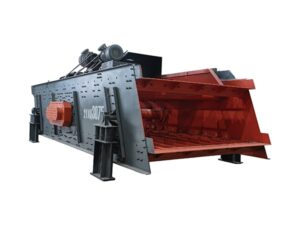
Screen geometry converts the duty into deck area and travel time. The YA/YAQ design uses approximately circular motion created by eccentric masses, while the inclined deck moves material toward discharge. The nominal screen-surface setting is 20 degrees, and listed models allow 18, 20, or 22 degrees. Any angle change should be checked against the required cut, residence time, and throughput.
Balance Screen Area and Deck Count
Width primarily controls bed depth, while length provides more opportunities for particles to meet an opening. University of Alaska guidance notes that width is selected for feed rate and optimum stratification. Within the HiDerek Mining Machine oil vibrating screen family, 2400 x 7000, 2700 x 7000, and 3000 x 7500 mm decks provide distinct areas. Select two or three decks according to the required product fractions.
Read Model Data as a Selection Envelope
Three representative configurations show why model selection should follow the duty rather than one headline capacity.
| Model | Deck and screen size | Listed capacity | Drive | Decision use |
| 2YAQ2470 | 2 decks; 2400 x 7000 mm | 250-560 t/h | 30 kW | Two-deck duty with moderate listed throughput |
| 3YAQ2770 | 3 decks; 2700 x 7000 mm | 350-700 t/h | 37 kW | Three product cuts within a larger deck area |
| 3YAQ3075 | 3 decks; 3000 x 7500 mm | 450-950 t/h | 37 x 2 kW | Highest listed throughput among these examples |
These ranges are not guaranteed plant outputs. Each listed mining vibrating screen also uses a nominal vibration frequency of 780/820 r/min and a double amplitude of 8-10 mm, but feed conditions determine achievable performance. Confirm the exact model, media, aperture sequence, support loads, chute arrangement, and motor voltage before approving drawings.
Control Feed Conditions at the Screen
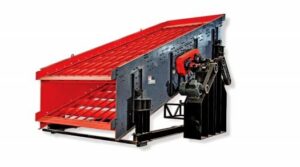
Stable feed presentation is as important as screen size. Material should enter across the usable width without a concentrated impact zone, because uneven loading creates different bed depths across the deck. The vibrating screens mining industry procurement teams compare should therefore be reviewed with the feeder, inlet chute, discharge chutes, and downstream conveyors as one operating interface.
- Provide normal, peak, and upset feed rates.
- Show feed and product size distributions, not only nominal sizes.
- Define aperture sequence, media material, and acceptable misplaced material.
- Identify dust control, water spray, impact liners, and lifting access.
Commissioning should verify performance with samples rather than motor current alone. Measure feed, oversize, and undersize gradations at steady state, then calculate recovery or misplaced material for each cut. A screening machine can be mechanically healthy while separating poorly if feed distribution, aperture condition, or angle is wrong. Record the baseline for later diagnosis.
Verify Reliability and Maintenance Access
Reliability questions should focus on the exciter, bearings, lubrication, deck access, media fastening, and structural inspection points. An oil vibrating screen quotation should identify oil grade, change interval, operating-temperature limits, seal arrangement, and alarm points only after the supplier confirms the exact assembly. Clarify the thin-oil design instead of inferring feed compatibility from the product name.
Manufacturing evidence should be tied to the offered machine. HiDerek Mining Machine lists a constant-temperature testing room, a three-coordinate measuring machine, processing and testing tools, and separate large- and small-item inspection areas. Ask which checks apply to the screen box, shafts, bearing seats, welds, and assembled exciter, then request the inspection plan.
Build a Quote That Engineers Can Use
A useful request for quotation gives the engineer enough information to size the machine and interfaces. Include material, density, moisture, maximum lump, full size distribution, cut sizes, normal and peak rates, operating hours, elevation limits, power supply, ambient conditions, and required products. Specifications for vibrating screens mining industry projects should also state whether the duty is dry or uses water spray.
HiDerek Mining Machine can review the duty against the YA/YAQ model range. Send the sieve analysis, flowsheet position, target fractions, and layout constraints, then request a marked-up datasheet showing selected model, apertures, motors, access, loads, and exclusions. This gives a vibrating screen for mining a measurable technical scope before price and delivery terms are compared.
FAQ
What Data Should I Send for Screen Selection?
A complete inquiry should include feed gradation, bulk density, moisture, clay content, maximum lump, target cuts, normal and peak rates, operating schedule, elevation, and power supply. This is the minimum information needed to assess a mining vibrating screen without relying on a generic capacity figure.
Is a Three-Deck Screen Always the Better Choice?
A three-deck unit is useful only when the flowsheet needs the additional separation. Extra decks add media, inspection points, and maintenance work. Choose the screening machine configuration from the number of required products and confirm access to every deck.
How Does Moisture Affect Screening?
Moisture can reduce stratification and encourage blinding, especially when clay or near-size particles are present. Acceptance plans for vibrating screens mining industry duties should define the expected moisture range and test separation with representative feed.