
Hydraulic Pump in Crusher Hydraulic Stations: Principles and On-Site Applications
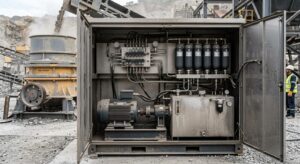
The hydraulic station is one of the most unassuming yet critical auxiliary systems on a crusher. Operations such as discharge opening adjustment, iron-jamming protection, and chamber clearing and reset are all driven by the hydraulic station. At the heart of the hydraulic station is the hydraulic pump. It converts the mechanical energy of the electric motor into the pressure energy of hydraulic oil, much like a heart pumps blood throughout the body.
There are two common types of oil pumps found on-site: gear pumps and plunger pumps. They look different, operate differently, and are used in different applications.
Gear Pumps: Simple, Durable, and Built for Heavy-Duty Work
The structure of a gear pump is straightforward. Inside the housing are two meshing gears—one driving and one driven. The motor drives the driving gear, causing the driven gear to rotate as well. On the suction side, the teeth of the two gears disengage, creating a larger space and a localized vacuum, which draws oil into the gear pockets under atmospheric pressure. As the gears rotate to the discharge side, the teeth re-engage, compressing the space and forcing the oil out under pressure.
This device has a simple structure, few parts, strong resistance to contamination, and is inexpensive. The drawbacks are that it cannot generate very high pressure, has significant flow pulsations, and produces noticeable noise.
In crushers, gear pumps are primarily used in two places:
The hydraulic station of a jaw crusher. Adjusting the discharge opening of a jaw crusher simply involves a hydraulic cylinder pushing once; the pressure requirements are low, and the action is infrequent. A gear pump is more than sufficient.
The lubrication stations for all models. Lubrication systems require high flow rates, low pressure, and continuous oil circulation. Gear pumps are ideally suited for this purpose, offering the lowest cost and minimal maintenance.
So when you see the hydraulic station next to a jaw crusher, or that small, standalone lubrication station next to a cone crusher, nine times out of ten, it contains a gear pump.
Piston Pumps: High-Pressure Precision, Built to Tackle the Toughest Challenges
The structure of a piston pump is much more complex. It consists of a cylinder block containing a ring of pistons, with the tops of the pistons resting against an inclined swash plate. The motor drives the cylinder block and pistons to rotate together, while the swash plate remains stationary but is set at an angle. As the cylinder block rotates, the pistons are forced back and forth within the cylinder bore by the swash plate. When the plungers are pulled outward, the volume of the cylinder bore increases, drawing in oil; when the plungers are pushed inward by the swash plate, the volume of the cylinder bore decreases, forcing out oil.
Plunger pumps can easily achieve pressures of 30 to 40 megapascals, and by adjusting the swash plate’s angle, the output flow rate can be smoothly regulated. This makes them virtually the only choice for applications requiring pressure maintenance, variable speed, or rapid response.
In crushers, plunger pumps are primarily found in three locations:
The main hydraulic station of a single-cylinder cone crusher. The large hydraulic cylinder at the bottom of the single-cylinder machine supports the entire main shaft and moving cone, operating at extremely high pressure. When processing iron, the pressure must be instantly relieved within a fraction of a second to allow the moving cone to drop and discharge the iron. Only a high-pressure plunger pump, combined with an accumulator, can provide this explosive force.
The locking station of multi-cylinder cone crushers. The ring of locking cylinders at the top of a multi-cylinder machine requires maintaining constant high pressure over long periods. A constant-pressure, variable-displacement plunger pump automatically reduces its displacement once the set pressure is reached, maintaining pressure without wasting power. If a gear pump were used for this task, it would continuously overflow at high pressure, causing the oil temperature to spike rapidly.
The hydraulic drive of mobile crushing plants. Many mobile crushers use an engine to drive a large-displacement variable-displacement plunger pump, which then distributes fluid to the travel motors and the main crushing unit motors. Plunger pumps offer high power density, which is a strict requirement for mobile chassis with limited space and weight constraints.
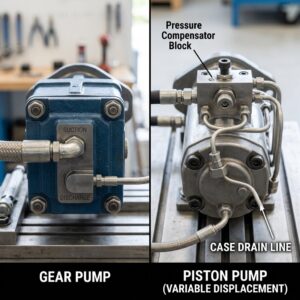
How can you tell the difference at a glance on-site?
No need to disassemble the machine—just open the hydraulic power unit cabinet door and look at the pump’s shape.
Square, with a cover secured by several bolts: gear pump. This indicates a system with low pressure and simple functionality.
Long cylindrical shape with a rotatable handle or dial on top: axial piston pump. This indicates the core hydraulic system, which operates at high pressure and is more expensive to manufacture.
Common Maintenance Mistakes
If a gear pump is noisy or unable to build pressure, don’t rush to disassemble it—most likely, the suction strainer is clogged or there’s an air leak at the suction line connection. A low oil level in the reservoir can also cause cavitation.
The most common issue with piston pumps is high oil temperature. The cause is often not the pump itself, but rather the system remaining in a constant overflow state for an extended period. When the system should be holding pressure, the pump continues to deliver full flow, and the excess oil returns to the reservoir via the relief valve, where it is converted into heat. Adjusting the relief valve setting or checking whether the constant-pressure variable mechanism has failed is a more practical solution than replacing the pump.
The hydraulic power unit plays a supporting role in a crusher, but if that supporting role is botched, the entire machine will still grind to a halt. Understanding the quirks of gear pumps and plunger pumps will help you avoid detours when encountering on-site problems.